Fractional CTO vs. Full-Time Hire: The SME’s Decision Framework
Updated 17 Mar 2026
Fractional CTO Australia: Why This Decision Costs Six Figures Either Way
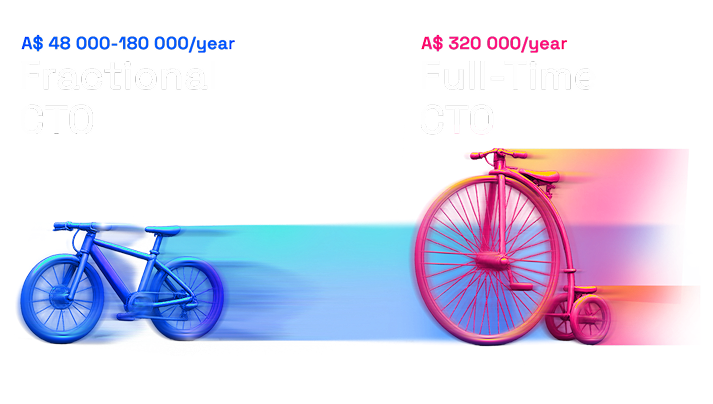
Fractional CTO services in Australia have become the default choice for SMEs that need senior technology leadership but cannot justify a full-time executive hire. The economics are straightforward: a full-time CTO in Sydney or Melbourne costs A$320,000+ annually when you factor in salary, superannuation, payroll tax, and recruitment. A fractional CTO delivers equivalent strategic guidance for A$48,000–180,000 per year.
But the decision is not purely financial. The wrong model creates expensive problems. A full-time CTO sitting underutilised in a business that needs 20 hours monthly of strategic guidance wastes A$200,000+ in excess capacity. A fractional CTO spread across multiple clients when your platform needs dedicated attention leaves critical decisions unmade.
This framework helps Australian SMEs match their technology leadership model to their actual needs.
The True Cost of Full-Time CTO Hire in Australia
Most founders look at base salary and stop there. This underestimates the real commitment by 35–40%.
According to Glassdoor Australia data from January 2026, the average CTO salary in Australia is A$236,500 per year. Clicks IT Recruitment reports the range at A$270,000–367,500 for experienced CTOs in Sydney and Melbourne.
But base salary is not total cost of employment.
True Cost of Ownership (Sydney/Melbourne, 2026):
Cost Component
Annual Amount
Base salary (median)
Source: Glassdoor AU, Jan 2026
A$236,500
Superannuation (12%)
Source: ATO rate effective July 2025
A$28,380
Payroll tax (5.45% NSW)
Source: Revenue NSW threshold A$1.2M
A$12,889
Leave entitlements (~10%)
Source: Fair Work NES
A$23,650
Workers compensation (~1%)
Source: Industry average
A$2,365
Recruitment fee (18%, amortised Y1)
Source: Scale Suite research
A$14,190
Equipment, software, training
Source: Industry estimate
A$8,000
The Australian Human Resources Institute reported that average recruitment costs reached A$23,860 per hire in 2021, more than double the 2020 figure. For executive roles, expect 3–6 months to fill the position, during which technology decisions either stall or get made by people without the expertise.
After Year 1, ongoing costs stabilise around A$300,000–310,000 annually once recruitment costs are removed.
Fractional CTO Cost in Australia: What to Expect
Fractional CTOs in Australia use three primary pricing models:
Hourly Rate:
A$150–500 per hour depending on experience and specialisation. Research from multiple Australian fractional CTO providers shows typical rates of A$200–350/hour for experienced practitioners. Best for ad-hoc consulting, specific problem-solving, or technical audits.
Monthly Retainer:
A$4,000–15,000 per month for 10–40 hours. This is the most common model for ongoing strategic guidance.
Project-Based:
Fixed fee for specific deliverables such as technology audits, architecture design, or vendor selection. Typical range: A$15,000–50,000 per project.
Annual Cost Comparison:
Engagement Level
Monthly Cost (A$)
Annual Cost (A$)
Hours/Month
Light touch
4,000
48,000
10–15
Standard
8,000
96,000
20–25
Intensive
15,000
180,000
35–40
Full-time CTO
N/A
326,000
160+
CTOx research indicates fractional CTOs typically cost 60–70% less than full-time executives while providing equivalent strategic guidance. The savings of A$146,000–278,000 annually can fund 1–2 senior developers who actually build the product.
When Fractional CTO Makes Sense for Australian SMEs
Stage-Based Indicators
Pre-Revenue / Seed Stage
You need execution, not strategy. A fractional CTO is typically unnecessary at this stage. Hire a technical co-founder or senior developer who writes code. Save the strategic layer for when you have product-market fit and real scaling decisions to make.
Post-Revenue / Series A (A$500K–5M revenue)
This is the primary market for fractional CTO engagement. You have customers and revenue. You need architecture decisions that will scale. You do not have A$326,000 annually to spend on technology leadership. A fractional CTO provides 10–25 hours monthly of senior guidance while your development team executes.
Series B+ (A$5M+ revenue)
Evaluate transition to full-time. If technology is core to competitive advantage and you consistently need 40+ hours weekly of dedicated leadership, the full-time model becomes economically rational.
Scenario Indicators
Your team is growing but velocity is dropping.
You added developers, but features ship slower. This usually indicates technical debt, architecture constraints, or process problems. A fractional CTO diagnoses the root cause and creates a remediation roadmap. This is exactly what companies describe in articles like “Why Most Tech Projects Fail When Scaling”.
You do not fully trust your development agency.
They keep saying “almost done” or “more complex than expected.” You need independent technical oversight to audit their work, validate estimates, and hold them accountable. A fractional CTO sits on your side of the table.
You are preparing for investment.
Investors will question your tech stack, security posture, and scalability. The “Technical Due Diligence” article covers what investors actually examine. A fractional CTO prepares you for these conversations and provides credibility in the room.
Your technology decisions happen episodically.
Major architecture choices, vendor selection, cloud migration, or compliance implementations happen quarterly, not daily. Paying A$326,000 for expertise you need 50 hours per year is poor capital allocation.
When Full-Time CTO Makes Sense
Scenario Indicators
Technology is your core product.
If you are building a technology platform rather than using technology to deliver services, dedicated technical leadership becomes strategic necessity. The distinction: a FinTech building payment infrastructure needs a full-time CTO; an accounting firm using cloud software does not.
You need 40+ hours weekly of technical leadership.
If your fractional engagement has crept to intensive levels (35–40 hours monthly) for 3+ consecutive months and you still need more capacity, the economics shift toward full-time.
You are managing 10+ developers.
Team management, performance reviews, hiring decisions, architecture reviews, and culture-building require consistent presence. Fractional models can support this, but the engagement hours approach full-time costs.
You have secured significant funding.
With A$5M+ in capital, the opportunity cost of not having dedicated technical leadership may exceed the salary cost. Speed of execution becomes more valuable than cost optimisation.
The Decision Matrix
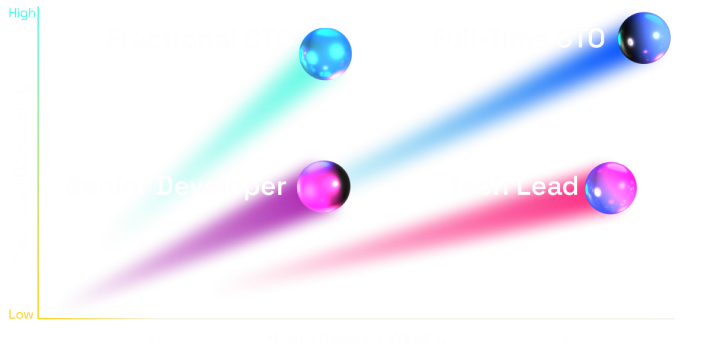
Factor
Fractional CTO
Full-Time CTO
Annual cost
A$48,000–180,000
A$300,000–400,000
Hours available
10–40/month
160+/month
Team size supported
1–10 developers
10+ developers
Revenue stage
A$500K–5M
A$5M+
Funding stage
Pre-seed to Series A
Series B+
Decision complexity
Episodic, high-stakes
Continuous, operational
Time to engage
1–2 weeks
3–6 months
Exit flexibility
Month-to-month
12+ months typical
The Hybrid Model: Fractional Leadership + Managed Services
For many Australian SMEs, neither pure fractional CTO nor full-time hire is optimal. The hybrid model combines fractional strategic leadership with managed technical services for execution.
How it works:
A fractional CTO provides strategic direction (10–20 hours monthly): technology roadmap, architecture decisions, vendor evaluation, team structure, compliance oversight.
A managed services team provides execution capacity: DevOps, cloud infrastructure, SRE, security monitoring, incident response.
Benefits for SMEs:
This model provides senior leadership without full-time cost, execution capacity that scales with demand, no recruitment overhead for either layer, and coverage for leave and turnover. You pay for what you use rather than maintaining excess capacity.
The model works particularly well for companies building FinTech products or EdTech platforms where compliance requirements demand senior oversight but day-to-day execution can be systematised.
What to Look for When Hiring Fractional CTO in Australia
Technical Competence
Look for architecture experience relevant to your stack, track record with similar-scale companies, and hands-on capability. A fractional CTO should be able to review code and make implementation decisions, not just produce strategy documents. For regulated industries, ensure they understand Australian requirements: Privacy Act, AUSTRAC if FinTech, relevant industry standards.
Communication and Availability
Fractional relationships depend on efficient communication. Define availability windows and response time expectations upfront. Ensure they can join investor calls, board meetings, and customer conversations when needed. Establish a structured reporting cadence: weekly async updates, monthly review calls.
Red Flags
Avoid candidates who cannot explain their approach without jargon, have not done hands-on technical work in 5+ years, are unwilling to commit to minimum engagement terms, cannot provide references from similar-stage companies, or promise specific outcomes before understanding your context.
Common Mistakes in the Technology Leadership Decision
Mistake 1: Hiring Full-Time Too Early
The most expensive error. A full-time CTO at A$326,000 annually costs the same whether utilised 20 hours or 160 hours monthly. If you only need 20 hours of strategic guidance, you are paying approximately A$270,000 for unused capacity.
The pattern: founders assume they need a CTO because “real companies have CTOs.” They hire before they have enough work to justify the role. The CTO either creates work to justify their salary (often building over-engineered systems) or becomes frustrated and leaves.
Solution:
Start fractional. Increase engagement as needs grow. Transition to full-time when utilisation consistently exceeds 30 hours weekly for 3+ months.
Mistake 2: Treating Fractional as Cheaper Full-Time
Fractional CTOs provide strategic leverage, not execution capacity. If you need someone writing code 40 hours weekly, hire a senior developer. If you need someone managing daily standups and writing tickets, hire a tech lead.
Fractional is for high-leverage decisions: architecture that will cost A$500,000 to change later, vendor selection that locks you into multi-year contracts, team structure that determines hiring for the next 12 months, compliance frameworks that determine audit outcomes.
Solution:
Define clear scope boundaries before engagement. Fractional for strategy and oversight. Dedicated team for execution.
Mistake 3: No Knowledge Transfer Plan
Whether fractional or full-time, technical leadership creates organisational knowledge. Architecture decisions, vendor relationships, security configurations, deployment processes. Without deliberate capture, that knowledge leaves when the person leaves.
Solution:
Require documentation as a deliverable. Architecture Decision Records (ADRs), runbooks, and team training should be explicit outputs of any engagement. The “Kubernetes and Infrastructure as Code” article covers how to systematise this in practice.
Mistake 4: No Success Metrics Defined
“Providing technology leadership” is not measurable. Without clear KPIs, you cannot evaluate whether the engagement delivers value. Six months and A$50,000–150,000 later, you cannot articulate what you got for it.
Solution:
Define 3–5 measurable outcomes at engagement start. Examples: reduce deployment failures by 50%, complete architecture documentation, pass security audit, reduce developer time-to-productivity from 4 weeks to 1 week.
Frequently Asked Questions
How much does a fractional CTO cost in Australia?
Fractional CTOs in Australia typically charge A$150–500 per hour or A$4,000–15,000 monthly on retainer. Annual cost ranges from A$48,000 (light engagement, 10–15 hours monthly) to A$180,000 (intensive engagement, 35–40 hours monthly). This compares to A$320,000+ total cost for a full-time CTO including salary, superannuation, payroll tax, and benefits.
When should an Australian SME hire a full-time CTO?
Consider full-time when technology is your core product (not just an enabler), you need 40+ hours weekly of technical leadership, you are managing 10+ developers, or you have secured A$5M+ in funding. Below these thresholds, fractional typically delivers better ROI.
What does a fractional CTO actually do?
A fractional CTO provides strategic technology leadership on a part-time basis: technology roadmap and architecture decisions, team structure and hiring guidance, vendor evaluation and selection, technical due diligence for investors, security and compliance oversight, and mentoring for technical team members. They think and guide; they typically do not write production code.
How quickly can we engage a fractional CTO?
Most fractional CTOs can begin within 1–2 weeks, compared to 3–6 months for a full-time executive hire. Initial discovery typically takes 1–2 sessions to understand your context, followed by a proposed engagement structure.
Can a fractional CTO work with our existing development agency?
Yes. This is a common and effective model. The fractional CTO provides independent oversight: validating estimates, reviewing architecture decisions, ensuring quality standards, and holding the agency accountable. This addresses the trust gap many SMEs experience with outsourced development.
The Wrong Choice Costs A$150,000+ Per Year
The fractional vs. full-time decision is not about which model is better. It is about which fits your context.
Hire full-time too early, and you pay A$326,000 annually for capacity you do not need. Hire fractional when you need dedicated presence, and your technology leadership is spread too thin. Either mistake costs six figures.
For most Australian SMEs with revenues between A$500,000 and A$5 million, fractional CTO engagement delivers senior technology leadership at 20–30% of full-time cost. The hybrid model, combining fractional strategic leadership with managed services for execution, offers senior guidance without full-time overhead and scalable capacity without recruitment burden.
Whatever path you choose, match your technology leadership model to your actual needs, not assumptions about what a company your size “should” have.
Not Sure Which Model Fits Your Business?
Fractional, full-time, or hybrid: the right choice depends on your specific context. Your team structure, growth trajectory, technical complexity, and budget constraints all factor into the decision.
Discovery Sprint includes technology leadership assessment.
In 5 days, we analyse your current situation and deliver a concrete recommendation: what model fits, what it should cost, and how to structure the engagement.
Download the full Discovery Sprint overview: what’s included, how it works, and what you get at the end.
Clients typically uncover A$40,000 to A$100,000 in unnecessary costs, delays, or architectural risks during the Sprint.
Download Discovery Sprint Overview
Related Articles
Disclaimer: Salary data represents median figures and may vary by location, industry, and company size. Cost calculations include estimates for statutory obligations current as of February 2026. This guide does not constitute employment or financial advice.
Ostride Labs: We build products with full compliance confidence. Code that passes audits. And ships fast.