DeFi FATF Compliance: AML Screening Without Killing UX
Updated 7 Apr 2026
DeFi lost A$5.2 billion to hacks in 2025. Regulators noticed. Now every project faces a choice. Build AML screening into your product. Or watch banks and partners walk away.
FATF compliance for DeFi is no longer optional. It is survival.
Most teams get this wrong. They force heavy KYC on every user. That kills 52% of sign-ups at the first step. Or they skip AML DeFi controls until late. That creates debt that explodes during audits.
The better path exists. Screen wallets before asking for ID. Trigger KYC only when risk justifies it. Put AML screening inside the product flow, not bolted on after.
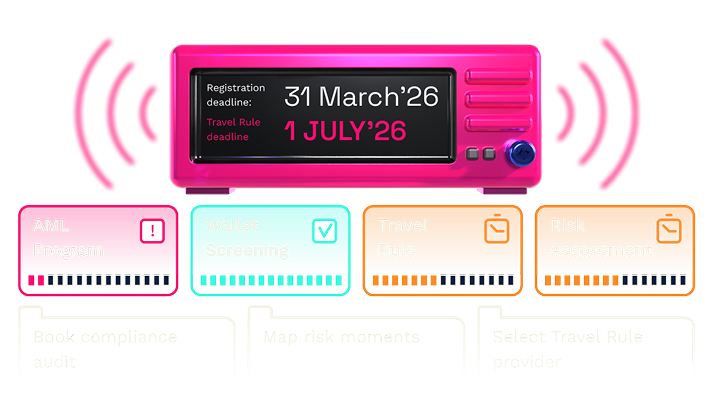
Australian DeFi teams face tight deadlines. AUSTRAC rules expand on 31 March 2026. Travel Rule starts 1 July 2026. This guide shows how to meet those dates without wrecking your user journey.

DeFi Compliance in 2026: What Changed
Global rules tightened fast. FATF now expects member countries to apply AML controls to all virtual asset services. That includes swaps, lending pools, and any protocol that moves tokens for users.
According to FATF’s 2025 update, 85 countries have passed Travel Rule laws. That is 31% more than 2024. Enforcement is speeding up.
This framework helps Australian SMEs match their technology leadership model to their actual needs.
- Crypto-to-crypto swaps
- Token transfers on behalf of users
- Custody and wallet services
- Token sales and offerings
AUSTRAC’s Crypto Taskforce found that 85% of high-volume crypto ATM users were linked to scams. That level of focus will spread to all virtual asset services.
The cost of ignoring this is real. Global AML fines hit A$7.1 billion in 2024. The first half of 2025 added A$1.9 billion more. Australian enforcement follows the same path.
What Works: AML Screening That Users Accept
Screen Wallets Before Asking for ID
Real case:
A Sydney DeFi lending protocol added tiered checks based on transaction size. Users under A$5,000 faced a simple wallet screen. Those above A$50,000 faced full ID checks. Sign-up completion rose from 48% to 71% in three months.
The catch:
Tiered systems need documented risk logic. AUSTRAC expects written reasons for each tier. If your thresholds look random, auditors will flag them. This team spent six weeks refining their model before launch.
AML screening at wallet connect is faster than blanket KYC. The system checks for sanctions links, mixer use, and known bad actors. Low-risk wallets move on. Medium-risk wallets face limits. High-risk wallets go to review.
This works because compliance friction is not neutral. Ask every user for passport scans at first touch. Watch them leave. Screen first. Verify when needed. Keep users moving.
Use Zero-Knowledge Proofs for Privacy
Real case:
A DeFi derivatives platform deployed zero-knowledge KYC in late 2024. Users verified once with a trusted provider. Then they proved compliance without sharing raw documents. Data exposure dropped 70%. Check speed rose 50%.
The catch:
The proof is only as good as the first check. FATF still expects a licensed firm to do the initial ID verification. Pure self-issued credentials do not satisfy AML defi rules.
The market for this tech is growing fast. Industry data shows the ZK-KYC market jumping from US$43.6 million in 2025 to US$903.5 million by 2032. That is 40% annual growth.
How it works: Users complete KYC once with a licensed provider. The provider issues a digital credential to the wallet. When accessing a DeFi service, the wallet creates a proof that says “I passed checks” without showing personal details. The protocol checks the math, not the identity.
Put Compliance Inside the Product Flow
Real case:
A Melbourne liquidity pool added on-chain compliance gates in early 2025. The smart contract checked proofs before allowing deposits above a threshold. Small deposits passed with no friction. The pool kept 89% of its previous users while meeting AUSTRAC rules.
The catch:
On-chain checks create a visible audit trail. Every rule fires publicly. This helps regulators but also shows competitors your methods. Code audits are critical. One bad rule can block real users or let bad actors through.
Smart contracts can check thresholds, test against sanctions lists, and limit by region. Google and major banks already use zero-knowledge age checks in wallet apps. The same tech applies to DeFi AML screening.

What Goes Wrong: Risks Teams Ignore
User Drop-Off Still Hurts at Scale
Heavy KYC kills conversion. Industry data shows 25% of users quit during identity checks on average. Crypto platforms see 60% to 80% drop-off for complex flows.
Document upload and wait times cause the most friction. Users who think a process takes too long will leave. Forms with seven or more fields see only 30% completion.
The fix is not removing compliance. It is redesigning flows. Progressive checks ask for less upfront. Users give more details only when accessing higher-risk features. This keeps early friction low while meeting rules for large transactions.
Connection Problems Between Systems
FATF does not mandate one data-sharing method. Different countries and providers use different protocols. A compliant Australian VASP sending to a compliant Singapore VASP may still fail Travel Rule rules if their systems do not talk to each other.
The “sunrise issue” makes this worse. Some countries enforce the Travel Rule. Others do not. As of early 2025, only 46% of FATF members fully apply it. More than half of potential partners operate under weaker rules.
For DeFi protocols, this means technical debt. You may need multiple Travel Rule tools to cover different regions. Each tool adds cost and failure risk.
Rule Confusion for Fully On-Chain Projects
Most regulators have not put Travel Rule duties directly on truly on-chain protocols. But they expect middlemen to apply rules where they can. FATF’s 2024 guidance says DeFi still needs watching for illicit finance risk.
The real question: does your protocol have someone in charge? If someone can update contracts, control governance, or direct development, regulators will find a person to hold responsible. True unchangeable code is rare. Most projects have upgrade paths, treasury controls, or foundation structures that create a link to regulation.
AUSTRAC takes the same view. They expect businesses to spot, manage, and reduce money laundering risks they can reasonably see. Calling yourself “decentralised” while keeping real control invites enforcement.
Decision Guide: Which Model Fits Your Protocol
Use this check to find your compliance needs.
Question 1:
Does your protocol have any known operator, governance body, foundation, or upgrade path?
Yes: You likely fall under VASP rules. Plan for full compliance.
No: Consider if this stays true long-term. Many “pure” DeFi protocols add governance later.
Question 2:
Do your users move more than A$1,000 in single transactions?
Yes: Travel Rule duties apply above thresholds. Plan for data collection.
No: Lower-value services face less scrutiny but still need suspicious matter reports.
Question 3:
What share of your users come from FATF-compliant countries?
Above 70%: Focus on Travel Rule tools with strong cross-border support.
Below 70%: Prepare for mixed rules across different regions.
Question 4:
Do you have staff for ongoing compliance work?
Yes: Build in-house with dedicated AML officers and systems.
No: Consider compliance-as-a-service providers who focus on virtual assets.
Priority actions:
- High exposure: Build tiered KYC with zero-knowledge options. Budget for compliance staff and reporting tools.
- Medium exposure: Deploy risk-based checks with smart contract gates. Partner with proven KYC providers.
- Lower exposure: Watch rule changes. Build compliance architecture that can switch on when needed.
Frequently Asked Questions
What are the main FATF compliance rules for DeFi in 2026?
FATF Recommendation 15 requires virtual asset services to run customer checks, transaction monitoring, suspicious matter reports, and Travel Rule data sharing. DeFi protocols with known operators fall under these rules. In Australia, AUSTRAC expects AML programs, risk reviews, and staff training before you offer regulated services.
Is FATF compliance worth the cost for Australian DeFi?
Yes, for any platform planning long-term regulated growth. Global AML fines topped A$7.1 billion in 2024. AUSTRAC has shown it will pursue crypto businesses through its Crypto Taskforce. Beyond fines, non-compliant platforms lose banking partners and fiat access. Compliant platforms report better trust from institutions and fewer fraud losses.
How long does DeFi compliance setup take?
Times vary by scope. Simple tiered KYC can go live in 8 to 12 weeks. Zero-knowledge proof systems need 12 to 20 weeks including vendor selection, coding, and testing. Full Travel Rule with multiple protocol support may take 6 months or more. AUSTRAC allows a grace period until 31 March 2026 for new sign-up rules. Travel Rule duties start 1 July 2026.
What AUSTRAC rules hit DeFi platforms?
The AML/CTF Amendment Act 2024 added crypto-to-crypto swaps, token transfers for users, custody services, and token sales. DeFi platforms must register with AUSTRAC by 31 March 2026. They must have AML programs running by 1 July 2026. Extra checks apply to high-risk users. Suspicious matter reports must go to AUSTRAC for any transactions that may link to money laundering or terror funding.
Can zero-knowledge proofs cut compliance costs?
Yes, when done right. ZKP checks run 50% faster than old KYC methods per research data. Storage costs drop because you verify proofs, not store documents. Data breach risk falls when you hold proofs instead of passport copies. But setup costs are higher than standard KYC. The tech needs specialist work. Savings grow as user numbers scale.
What risks come from skipping FATF compliance?
Non-compliant platforms face fines, lost banking partners, and possible criminal charges for operators. AUSTRAC can impose civil penalties, cancel registrations, and send cases for prosecution. Beyond direct enforcement, non-compliance creates day-to-day risk. Banks ask for compliance proof before processing fiat. Institutions may exclude coverage for platforms without documented AML controls.
Key Takeaways
DeFi compliance is not a binary choice between rules and user experience. The tech exists to verify identity without exposing personal data. Smart contracts can enforce compliance rules on their own. Risk-based systems can match scrutiny to actual threat levels.
For Australian DeFi teams:
- AUSTRAC duties expand from 31 March 2026. Registration and AML program rules apply to platforms with known operators.
- Zero-knowledge proofs offer privacy-safe compliance. The tech cuts data exposure by 70% while meeting rule requirements.
- Tiered checks based on risk reduce drop-off. Platforms that apply the same friction to all users lose both low-value customers and compliance efficiency.
- Connection problems need multi-protocol Travel Rule tools. No single tool covers all countries and partner types.
Build compliance as a product feature, not a burden. Users expect protection alongside freedom. Meeting that bar requires work now, before the deadline hits.
Start Your DeFi Compliance Audit
Building compliance into a DeFi protocol needs both rule knowledge and technical skill. The gap between compliance duties and user experience can close only with the right architecture.
Ostride Labs builds eKYC and identity verification for DeFi platforms. Our engineering teams have deployed privacy-safe compliance systems for regulated financial products across Australia and beyond.
If your protocol needs Travel Rule setup, zero-knowledge KYC design, or AML program architecture, our compliance and architecture services provide the technical base.
Start with a DeFi Compliance Audit to map your current exposure and build a priority action plan. Our Discovery Sprint delivers a complete technical spec, compliance gap analysis, and fixed-price quote within five business days.
Book DeFi Compliance Audit
Ostride Labs. We build products with full compliance confidence.